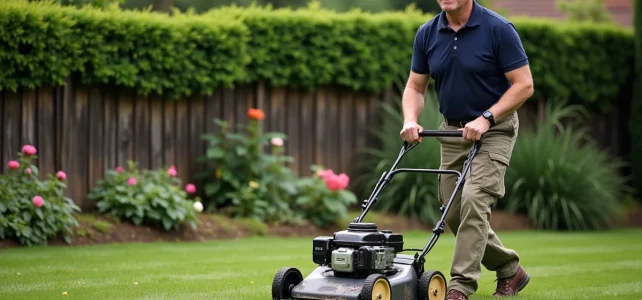
The market for thermal mowers remains broad, with engines ranging from small displacements for modest lawns to more robust units designed for plots over a thousand square meters. Choosing the best thermal mower involves going beyond just reading a technical sheet: fuel compatibility, actual noise level, type of housing, and cutting logic weigh as much as the engine’s raw power.
Fuel Compatibility of Thermal Mowers: A Common Pitfall When Buying
Since SP95-E10 has become the most widely distributed gasoline in France, the question of fuel arises as soon as the machine is chosen. Briggs & Stratton, Honda, and other engine manufacturers recommend checking if the engine accepts E10. If not, one must revert to regular SP95 or alkylate fuels designed for small garden engines.
The issue goes beyond mere compatibility. An engine fueled with unsuitable gasoline clogs up faster, and premature breakdowns related to ethanol in the system are a recurring reason for service visits. Before purchasing, looking for the mention of E10 compatibility in the manufacturer’s manual can help avoid unexpected maintenance costs.
Online comparisons, which often focus solely on displacement and power, overlook this constraint. To cross-reference the technical sheets of different models, specialized resources like tondeuse-thermique.info allow for data comparison before making a decision.
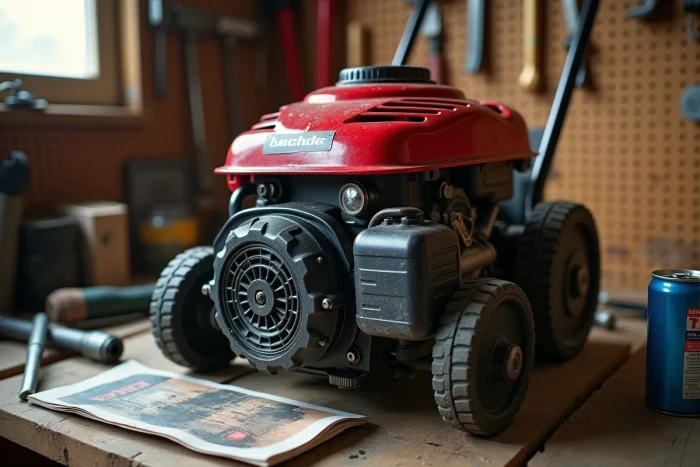
Noise and Local Regulations: What Product Sheets Don’t Tell You
Several French municipalities have tightened their municipal noise regulations since 2023-2024. Mowing time slots are being reduced, particularly on weekends, and some texts impose lower noise levels for gardening equipment. These restrictions do not only target thermal mowers, but they effectively penalize the noisier models.
The noise level announced by the manufacturer becomes a real selection criterion, not just a detail on the technical sheet. A difference of a few decibels between two models can make the difference between mowing allowed on Saturday morning and usage limited to weekday afternoons.
Guidelines for Reading Displayed Decibels
Manufacturers measure noise according to standardized protocols, but real conditions (tall grass, sloped terrain) increase engine load and perceived volume. The presence of a reinforced muffler or soundproof housing on certain models significantly reduces disturbances.
- Check the guaranteed sound power (LWA) rather than the sound pressure at the workstation, which is always more flattering.
- Compare models with equivalent cutting widths: a wider housing often generates more noise at comparable speeds.
- Consult your municipality’s municipal order before purchasing to know the authorized time slots and any potential decibel limitations.
Cutting Width and Land Area: Adapting the Thermal Mower to Your Lawn
All competitors remind us, and for good reason: the cutting width determines the time spent mowing. For modest areas, a blade of 41 to 46 cm is sufficient. Beyond a thousand square meters, models with a cutting width of 48 to 55 cm significantly reduce the number of passes.
On the other hand, a large cutting width implies a heavier housing and a machine that is less maneuverable in cluttered areas (beds, trees, narrow borders). On uneven or heavily planted terrain, a mid-sized model with good maneuverability will be more effective than a wide machine that is difficult to pilot around obstacles.
Self-Propelled or Push Mower
On flat and clear terrain, a push mower remains a rational and less expensive choice. As soon as there is a slope or the area exceeds a few hundred square meters, self-propulsion significantly reduces fatigue. Self-propelled models add weight and an additional cost factor (transmission, belt), but the gain in mowing comfort justifies the investment for most family gardens.
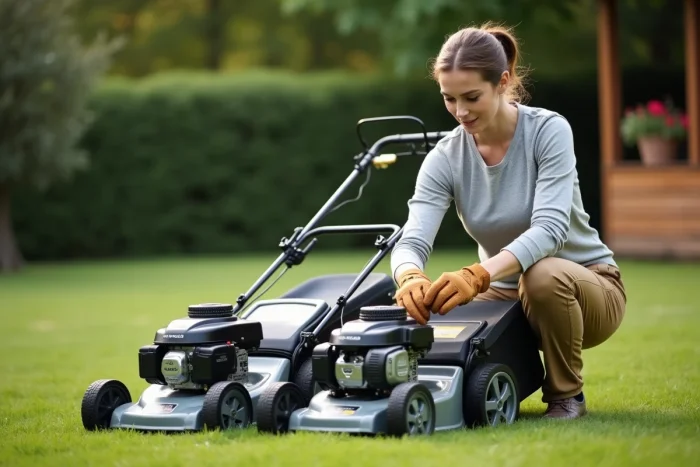
Engine and Reference Brands: Honda, Husqvarna, and Others
Honda and Husqvarna dominate discussions about the reliability of thermal mower engines. This reputation is based on consistent field feedback: longevity of the block, availability of parts, network of repairers. Briggs & Stratton also powers a significant share of the market, including on third-party brand chassis.
Field feedback diverges on this point: a Honda engine mounted on a cheap chassis does not guarantee the same overall durability as a machine integrated by the same manufacturer from start to finish. The quality of the housing, wheels, and height adjustment system is as important as the engine.
Mulching, Collection, or Side Ejection
The choice of cutting system depends less on the brand than on actual usage. Mulching finely shreds the grass and redeposits it on the lawn, which nourishes the soil and avoids emptying a bag. This technique works well on a regularly mowed lawn with grass that is not too tall.
- Collecting with a bag is suitable for infrequent mowing or lawns where an immediate clean finish is desired.
- Side ejection is intended for large rustic areas where aesthetics are secondary.
- Some models offer all three modes, providing flexibility but adding cost and some mechanical complexity.
Maintenance of the Thermal Engine: What Preserves the Machine Over Time
A well-maintained thermal mower lasts several more years than a neglected machine. Replacing the spark plug, cleaning the air filter, and changing the engine oil at the beginning of the season constitute the minimal foundation. Sharpening or replacing the blade at least once a year ensures a clean cut and limits engine overload.
At the end of the season, emptying the fuel tank (or adding a stabilizer) prevents residue buildup in the fuel system, a problem amplified by fuels containing ethanol. This simple gesture reduces starting difficulties the following spring and extends the life of the carburetor.
The choice of a thermal mower relies on a balance between land area, noise constraints, fuel compatibility, and maintenance budget. A model suited to the reality of the garden costs less than an oversized model poorly utilized. Taking the time to check these points before purchasing remains the best guarantee of a well-maintained lawn season after season.