
Between a compact pruning chainsaw and a battery-powered telescopic pole, the choice depends on measurable parameters: cutting diameter, battery voltage, weight in working position, guide length. Comparing these technical data allows you to target the model suited to the actual configuration of your garden, without overpaying for unnecessary power or underestimating your needs.
Normative safety of pruning saws: what the European regulation 2023/1230 changes
The EU regulation 2023/1230 of June 14, 2023, concerning machines gradually replaces the old Machinery Directive. For pruning saws, this regulatory evolution translates into strengthened requirements on three points: the anti-rebound system, the sensitivity of the chain brake, and the protection of the operator’s hands.
Updates to the EN ISO 11681-1 standard accompany this regulation. Manufacturers must now integrate devices that, a few years ago, went beyond the standard as standard equipment. When choosing a pruning saw, checking compliance with the new regulation ensures a higher level of safety, especially on entry-level models where such equipment was sometimes optional.
To delve deeper into the technical specifications of the various models available, the detailed sheets published on elagueuse-warrior.com allow for comparison of the integrated safety devices according to the ranges.
Gas, battery, or corded pruning saw: comparative table of power sources

The type of power source determines autonomy, weight, noise level, and the diameter of branches you can cut. Here is a summary of the differences between the three families.
| Criterion | Gas | Battery (36-40 V) | Corded Electric |
|---|---|---|---|
| Cutting power | High, suitable for large diameters | Medium to high depending on voltage | Medium, limited by the motor |
| Autonomy | Unlimited (tank) | Variable depending on capacity (Ah) | Unlimited (mains) |
| Weight | Heavier | Intermediate | Lightest |
| Noise level | High | Low to moderate | Moderate |
| Engine maintenance | Regular (spark plug, filter, fuel) | Minimal | Minimal |
| Mobility | Total | Total | Limited by the cord |
In urban areas, municipalities and green space services have largely adopted battery models since 2023-2024, due to noise and air quality constraints. This shift has accelerated the upgrading of 36-40 V battery pruning saws, whose cutting performance now approaches that of gas models on medium diameters.
Conversely, for isolated terrain with large trees, gas models still hold a clear advantage for long sessions and hard woods of large diameter.
Pruning chainsaw or telescopic pole: choose based on cutting height
The confusion between these two tool formats remains common. However, their uses differ radically.
The pruning chainsaw is a compact, lightweight tool designed to work at height from a platform or harness. Its short guide (generally around 25 cm) makes it maneuverable for precision cuts on small to medium diameter branches. It is aimed at users who climb trees or work from a secured ladder.
The telescopic pole allows cutting from the ground, without leaving solid ground. Its telescopic length reaches several meters, which is sufficient for most maintenance pruning in residential gardens. However, the weight at the end of the pole generates quick fatigue, especially after a few minutes of continuous use in a high position.
- Telescopic pole: ideal for branches up to four to five meters high from the ground, without climbing equipment
- Compact pruning chainsaw: suitable for interventions in the tree crown, requires access at height
- Articulating head pole: allows reaching branches at an angle, useful on trees with complex branching
Guide length and chain: technical criteria for cutting
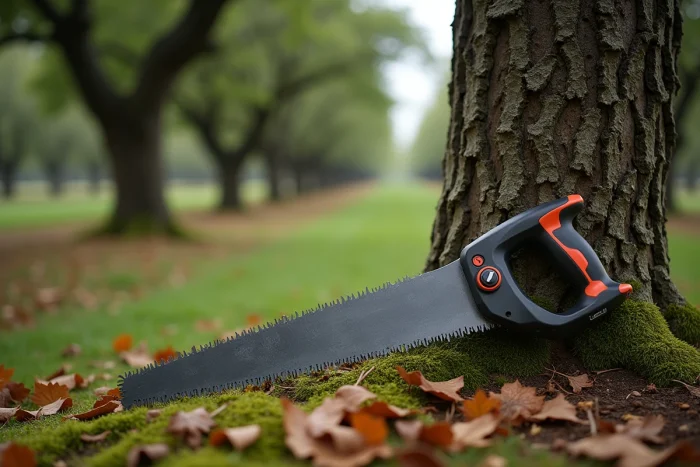
The length of the guide bar directly determines the maximum diameter of branch that the tool can cut in a single pass. A 25 cm guide is suitable for small caliber branches, typical of regular maintenance (fruit trees, woody hedges, dead wood). A longer guide increases cutting capacity but adds weight and reduces maneuverability.
The chain pitch and tooth profile also play a role. Reduced pitch chains offer finer cuts with less vibration, making them better suited for precision work. Standard pitch chains cut faster but require more motor power.
Two often overlooked points when purchasing:
- The availability of replacement chains for the chosen model (some references are hard to find after a few years)
- The compatibility of the guide with the tool-less chain tensioner, which facilitates adjustment on-site
- The presence of an automatic chain lubrication system, which extends the lifespan of the guide bar and chain assembly
Connected batteries and preventive maintenance: a trend changing the choice
Since 2024, brands like Stihl, Husqvarna, or Pellenc have integrated connected functions into their professional ranges: usage tracking, tool geolocation, battery diagnostics via app. This logic of preventive maintenance through smart batteries is beginning to spread to consumer ranges.
Charge cycle counters and integrated diagnostics allow for anticipating battery replacement before it loses too much capacity. For an individual who uses their pruning saw a few times a year, this aspect may seem secondary. It becomes relevant as soon as the tool is shared (co-ownership, collective use) or stored for several months without use.
The choice of a battery platform compatible with multiple tools from the same manufacturer remains the most structuring economic criterion. Investing in a coherent battery ecosystem (hedge trimmer, blower, pruning saw) reduces overall costs and simplifies fleet management.
The pruning saw best suited to your garden is not the most powerful or the most expensive, but the one whose motorization, format, and guide length match the trees you actually prune. The new European regulatory framework and the rapid upgrading of battery models are reshuffling the cards: a well-chosen 36-40 V model now covers the majority of residential maintenance needs.