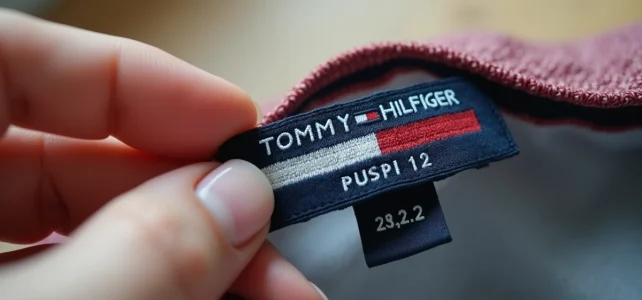
You buy a Tommy Hilfiger polo on a marketplace, you receive it, and right from the unboxing something seems off: the font on the collar tag looks slightly different, and the red-white-blue tricolor flag appears misaligned. This kind of doubt can be resolved in under two minutes when you know where to look. The tag is the first element to inspect, well before the seams or the fit of the garment.
Typography and Flag on the Tommy Hilfiger Collar Tag
On an authentic garment, the logo embroidered or printed on the collar tag follows a constant: the rectangular flag is divided into three sharp segments (dark red, white, navy blue), with clean edges. Counterfeits often betray a flag with slightly off colors, a blue leaning towards purple or a red that is too orange.
The typography of the name “TOMMY HILFIGER” uses a very specific serif font. Each letter is evenly spaced. An irregular spacing between letters almost always indicates a fake. Counterfeits also show characters that are thicker or thinner than the original, sometimes with a final “G” whose horizontal bar is too short.
To verify, you can directly compare with a high-resolution photo of an item sold on the official site fr.tommy.com. The differences, even subtle ones, become evident when you place the two images side by side on a screen.
A complete guide allows you to recognize a genuine Tommy Hilfiger through the tag by detailing each control area, from the collar to the inner seam.
Composition Label: Multilingual Mentions and European Compliance
This is the point that most buyers overlook, and it is the one that traps the most recent counterfeits. Tommy Hilfiger garments sold in the European market comply with Regulation (EU) No. 1007/2011 on textile fibers. In practical terms, this imposes specific obligations on the inner composition label.
- Composition mentions appear in several languages, including French, German, Italian, and Spanish at a minimum. A label in English only, for an item sold in Europe, is a strong warning signal.
- The naming of materials follows a standardized nomenclature: you read “100% organic cotton” or “recycled polyester,” never marketing phrases like “premium cotton” or “authentic fabric.” Counterfeits often mix technical composition and advertising language on the same label.
- An address of an importer based in the European Union must be present somewhere on the label or on an adjacent label. Its absence is an indication of non-compliance.
This last criterion is particularly useful when buying second-hand: even a Tommy Hilfiger garment from several seasons ago retains these regulatory mentions, and they remain verifiable.
QR Codes and Digital Authentication on Recent Collections
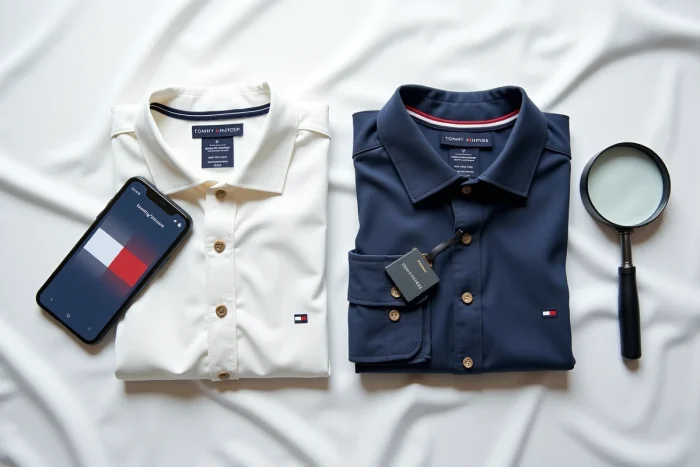
For a few seasons now, Tommy Hilfiger has integrated labels with QR codes on certain segments, notably denim and recent capsules. Scanning this code redirects to an official product page hosted on the tommy.com domain, sometimes with a geographic location verification.
A QR code that redirects to a third-party site or a generic page is a marker of counterfeiting. Counterfeiters sometimes reproduce a QR code, but it points to a URL unrelated to PVH Corp (the parent company of Tommy Hilfiger) or leads to a 404 page.
How to Effectively Test the QR Code
Scan with the phone’s native camera, not with a third-party app. Before clicking on the link, check that the displayed URL starts with “tommy.com” or an official subdomain. If the link redirects multiple times before landing somewhere, close it immediately.
Feedback varies on this point: not all Tommy Hilfiger items yet have a QR code. Its absence does not automatically mean a counterfeit, especially on older lines or basics like plain t-shirts. However, its presence and correct redirection constitute strong proof of authenticity.
Stitching and Finishing of the Tag: Details That Don’t Lie
Beyond the printed content, the physical quality of the tag itself gives clues. On an authentic Tommy Hilfiger garment, the collar tag is sewn with regular, tight stitches, and the edges of the tag do not fray.
Counterfeits often exhibit loose or asymmetrical stitching at the tag attachment point. Sometimes, threads stick out from the very first wear, or a tag is glued rather than sewn on models where stitching is the norm.
Size Tag and Positioning
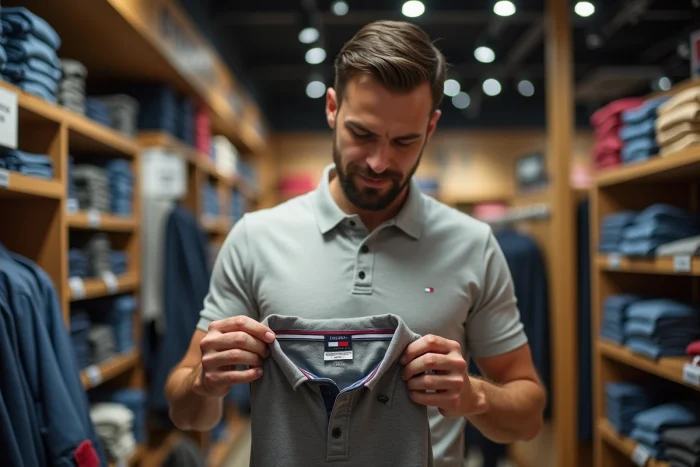
On polos and shirts, the size tag is generally integrated under the main tag, centered in the collar. A visible shift to the left or right, or a size tag placed on the side of the garment when the original model positions it at the collar, indicates non-compliant manufacturing.
Comparing with an identical item purchased in an official store remains the most reliable method. Serious second-hand sellers provide detailed photos of all tags. If a seller refuses to photograph the inner label or the composition, move on.
The label of a Tommy Hilfiger garment tells much more than just a brand name. Typography, European regulatory compliance, QR code, stitching quality: each layer of information reduces the margin of doubt. In the second-hand market as well as on online sales platforms, taking thirty seconds to flip the collar is often enough to avoid a bad deal.