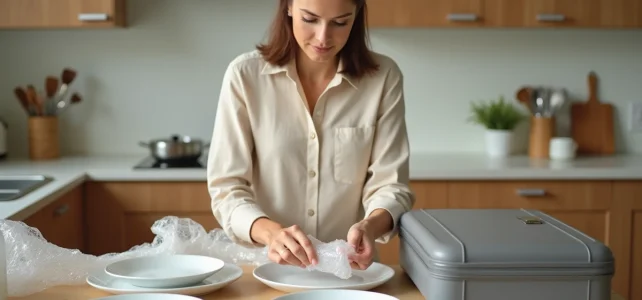
You return from a flea market in Lisbon with a hand-painted ceramic plate. It fits in your carry-on bag, but will it pass security? This question arises with every trip, and the answer depends as much on the material as on the shape of the object.
Transporting dishware in carry-on luggage is generally allowed, provided you know the limits set by airline regulations and the practices of each airport.
Further reading : How to Solve a Webmail Connection Issue in Grenoble: Tips and Effective Solutions
Dishware in carry-on and security checks: what triggers an inspection
The X-ray scanner does not distinguish a cup from a suspicious object based solely on its silhouette. What catches the agents’ attention is the density of the material and the sharpness of the contours. A thick porcelain plate or an enameled cast iron dish generates an opaque image, similar to that of a compact metallic object.
Direct consequence: your luggage will be opened for a manual check. This is not a prohibition, just an additional check that takes a few minutes. Several European airports are now deploying next-generation 3D scanners. These devices provide a more detailed image and reduce manual checks on opaque objects, but they do not change the fundamental rules.
See also : What You Need to Know About Upcoming Laws in 2025 and Their Impact
The real criterion for refusal is the sharp edge. A shard of ceramic or a sharp edge can be considered a sharp object by the security agent. If you already know the rules for carry-on dishware, you know that this assessment remains at the discretion of the personnel at the checkpoint.
Accepted and refused materials in carry-on luggage
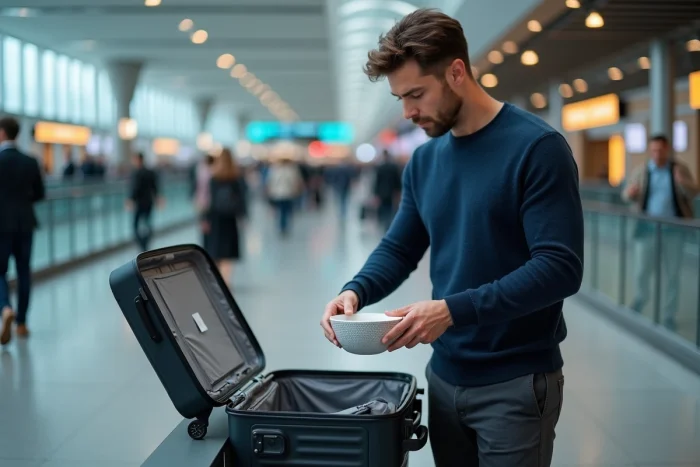
Not all types of dishware pose the same problem. The material determines both the risk of breakage and the likelihood of refusal at the checkpoint.
- Ceramics, porcelain, stoneware: allowed in the cabin as long as the edges are smooth and not chipped. A cracked bowl with a sharp edge may be confiscated.
- Ordinary glass and crystal: generally accepted, but a broken glass in flight becomes a sharp object. The risk of breakage often justifies prioritizing the hold with reinforced packaging.
- Melamine, bamboo, wood: these lightweight and unbreakable materials pass without difficulty. No documented cases of refusal for this type of dishware.
- Metal (stainless steel, copper, tin): metal dishes and bowls are allowed. Table knives, even with rounded tips, remain prohibited in the cabin according to IATA regulations on sharp objects.
A point often overlooked: if your dishware contains remnants of sauce, jam, or liquid, the small container rule applies. Some British airports have actually reintroduced the classic liquid container limit in 2025, after a temporary relaxation related to the new scanners. A bowl filled with condiment may be treated as a prohibited liquid depending on the departure airport.
Packaging your dishware for the cabin: practical technique
The hold can be rough on luggage, but the cabin is not without risks. Sudden braking on the ground, a shared overhead compartment with a hard suitcase: impacts do occur. Packaging makes the difference between an intact souvenir and a pile of debris.
The layered method to protect each piece
Wrap each item individually in bubble wrap or, if unavailable, in a thick garment like a wool sweater. Two layers of protection minimum around each piece are sufficient to absorb moderate impact.
Place the wrapped items in the center of the bag, surrounded by soft clothing. The bottom and sides of the luggage serve as a buffer zone. Avoid placing dishware against the hard wall of a shell suitcase: polycarbonate transmits shocks instead of absorbing them.
Tips for fragile or bulky pieces
For a teapot or a vase, fill the hollow interior with rolled-up socks. The empty space inside an object is the primary cause of fractures: the wall vibrates and gives way under external pressure. Filling the internal void divides the risk of breakage.
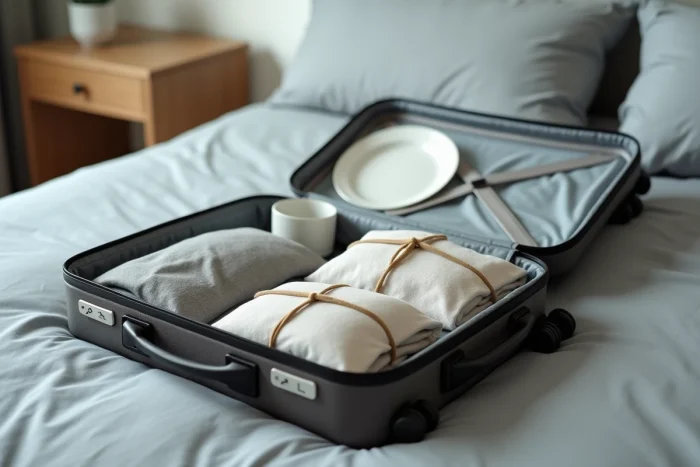
If you are transporting several plates, intersperse a sheet of bubble wrap or a folded cloth between each piece. Never stack them bare: friction between two glazed surfaces causes chips, even without violent impact.
Low-cost airlines and carry-on bag dimensions: the weight trap
Security regulations allow your dishware, but your airline may complicate things. Low-cost carriers impose strict weight limits on carry-on luggage, sometimes around just a few kilograms. A ceramic tea set is heavy and can tip the scales at boarding.
Check the weight allowance of your ticket before filling your bag. In case of doubt, distributing the dishware between the carry-on bag and a checked bag remains the safest solution to avoid extra fees at the boarding gate.
Another point to anticipate: some airlines only allow a small personal bag with no access to the overhead compartment. Your dishware then ends up under the seat in front of you, in a reduced space where a rigid object can inconvenience the neighboring passenger.
Bringing dishware on a plane is not a problem in principle, provided you check three things before departure: the condition of the edges (no sharp edge), the absence of liquid inside, and the total weight relative to your ticket limits. The rest is a matter of careful packaging and common sense when passing through security.