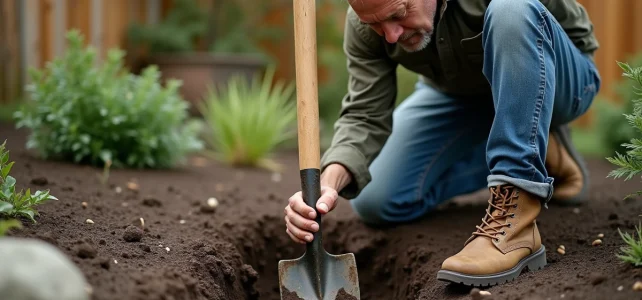
When you encounter compacted soil after construction work or a prolonged drought, the classic shovel bounces with every strike. The problem doesn’t always stem from the tool, but from the way you approach the ground. Effectively digging a hole with a shovel in your garden relies on three elements: soil preparation, choosing the right technique, and work rhythm.
Compacted soil in suburban areas: preparing the ground before digging
In recent developments, the soil has often been compacted by the passage of construction machinery. Since 2022, INRAE has documented an increase in surface compaction issues in urban and suburban soils. This phenomenon worsens with the alternation of drought and heavy rains, which creates a hard crust on the top few centimeters.
Attacking this layer directly with a shovel is a waste of time and energy. Pre-humidifying the soil the day before radically changes the effort required. You generously water the area to be dug, then let the water penetrate overnight. The next day, the soil breaks apart into clumps instead of resisting as a block.
On very compacted soil, it’s beneficial to first break the surface with a fork-spade rather than with the shovel. The fork penetrates more easily between the hard aggregates. Once the top few centimeters are loosened, the shovel takes over to remove the soil. Knowing how to dig a hole with a shovel primarily involves this decompaction step, which most guides overlook.
Shoveling technique: posture and movements to dig without injury
The National Health Insurance Fund reminds us in a 2023 fact sheet that deep digging work beyond fifteen to twenty minutes in a row significantly increases the risk of lower back pain and tendinopathies. This is not a detail: poor posture turns a planting hole into a work stoppage.
The correct body placement for each shovel stroke
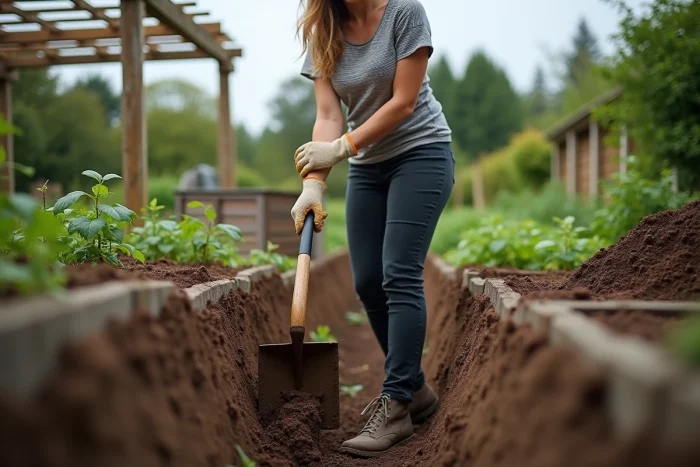
One foot is placed on the upper edge of the blade to push the shovel in, using body weight rather than arm strength. The back remains straight, with knees slightly bent. The leverage comes from the legs, not the lower back.
When lifting the soil, bring the load closer to the body. The lower arm on the handle acts as a pivot, while the upper arm guides the direction. Pivot with your feet rather than twisting your torso while keeping your feet fixed, a common reflex that dangerously strains the back.
Alternating and taking breaks to last on a gardening project
The CNAM’s recommendation is practical: alternate the supporting arm and leg every ten shovelfuls. In practice, regularly switch your dominant side, and break the work into short sessions interspersed with stretches.
- Alternate the supporting foot on the blade every ten strokes to distribute the muscle load
- Take a two to three-minute break every fifteen minutes of continuous digging
- Stretch the back and shoulder muscles between sessions, even if you don’t feel pain
- Use a shovel with a handle that reaches shoulder height to limit excessive bending
A shovel that is too short forces you to bend more with each stroke. This point may seem trivial, but for a fruit tree planting hole, we are talking about several hundred shovel strokes. The cumulative effect makes the difference between a manageable project and soreness that lasts a week.
Round shovel or square shovel: adapting the tool to the type of hole
Competitors often list tools (spade, pickaxe, auger) without explaining which blade profile to choose for which use. The shape of the shovel directly affects the efficiency of digging.
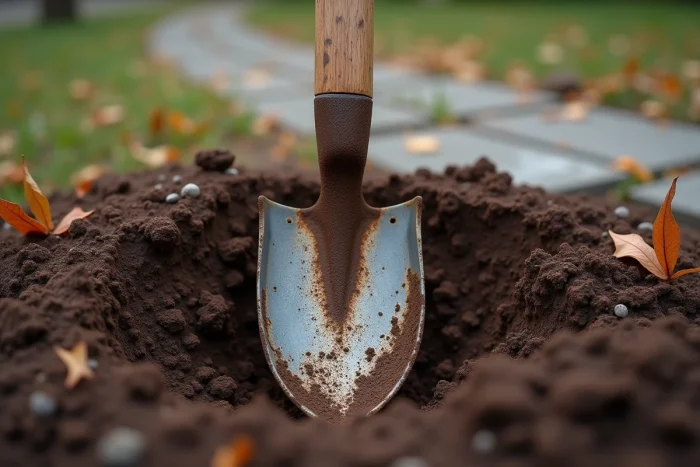
The round-bladed shovel (known as the digging shovel) penetrates better into unworked soils. Its tip concentrates pressure on a small surface, which helps to pierce clayey or compacted soil. It’s the right choice for digging a planting hole, a hole for a post, or a narrow trench.
The square-bladed shovel excels at another task: collecting and moving already loosened soil. Its wider surface allows for more to be loaded with each scoop. It is used as a complement, not a replacement.
On a typical gardening project, the most effective sequence combines both:
- Fork-spade to break the surface crust if the soil is hard
- Round shovel to dig and detach clumps from deeper down
- Square shovel to remove soil from the hole to the wheelbarrow or pile
Opinions vary on the usefulness of a pickaxe as a complement. On rocky soil, it remains the only tool capable of dislodging stuck stones. On loose or sandy soil, it slows down more than it helps.
Digging a planting hole: dimensions and common mistakes
A planting hole for a shrub or tree should be wider than it is deep. Aim for a diameter at least twice that of the root ball or container of the plant. A hole that is too narrow prevents roots from colonizing the surrounding soil, which limits recovery.
The most common mistake is smoothing the walls of the hole with the back of the shovel. This action creates a pot effect: the walls become compact, and the roots circle instead of spreading. Instead, scratch the edges with the tip of the shovel or a fork to leave an irregular surface.
Another trap: putting the excavated soil back around the root ball as is. If the soil is very clayey, mix the excavated soil with compost or potting soil to improve drainage. The bottom soil of the hole (often more compact and less fertile) should go on top of the pile, not around the roots.
Digging effectively in the garden is not a matter of brute force. Prepared soil the day before, a shovel suited to your height, movements that protect your back, and a hole of the right dimensions save time on each planting. The best investment remains taking five minutes to observe the soil before driving in the blade.