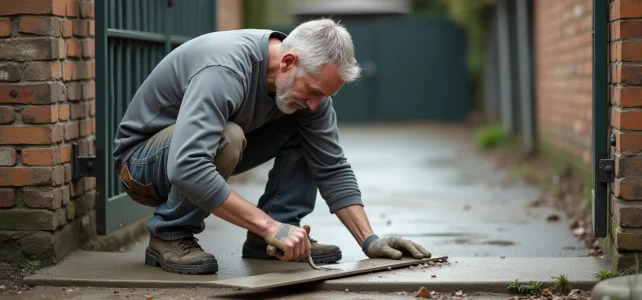
A sagging or cracked gate threshold is not just a visual issue. The defect alters the swing of the door, accelerates wear on the rail, and can block closure after a few seasons of bad weather and repeated vehicle passage. Before choosing between self-leveling compound and masonry repair, the question is what level difference separates the current situation from the expected result, as the answer directs towards very different products, thicknesses, and costs.
Self-leveling compound or formwork on gate threshold: a comparison of techniques based on the defect
The choice between self-leveling compound and formwork repair directly depends on the extent of the observed defect. The table below summarizes the decision criteria.
| Criterion | Self-leveling compound | Formwork and concrete pouring |
|---|---|---|
| Thickness of correction | Few millimeters, suitable for slight irregularities | Several centimeters, suitable for structural sagging |
| Support preparation | Cleaning, dusting, bonding primer | Partial excavation, possible reinforcement |
| Drying time before recommissioning | Few days depending on the product | At least seven days before vehicle passage |
| Resistance to vehicle traffic | Limited if the thickness exceeds the product data sheet | High with appropriate cement-sand mix |
| Indicative cost | Low per square meter | Significantly higher per linear meter |
In practice, self-leveling compound is suitable when the surface is generally flat but rough or slightly recessed. As soon as the gap exceeds what the product technical data sheet allows, formwork with new pouring becomes the only reliable option. Applying a self-leveling compound at too great a thickness leads to rapid delamination under the weight of a vehicle.
To delve deeper into the techniques suitable for each situation, a comprehensive guide on self-leveling and threshold correction details the implementation steps according to the type of defect encountered.
Preparation of concrete support: the factor that most renovations overlook
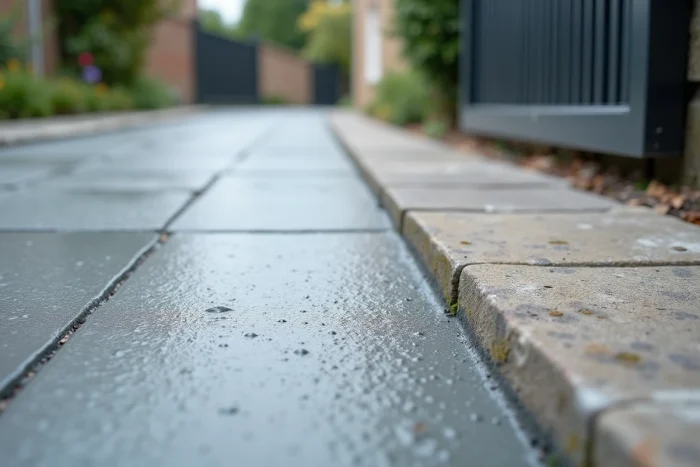
The durability of the self-leveling compound depends less on the chosen product than on the condition of the support at the time of application. Old concrete, smoothed or soiled by residues of moss and engine grease, prevents any proper adhesion.
Preparation sequence before exterior self-leveling
- Remove all friable parts, concrete chips, and old non-adhering coatings using a chisel or a grinder equipped with a diamond disc.
- Dust the surface with a blower or construction vacuum, then wash with a pressure washer to eliminate grease and organic residues.
- Apply a bonding primer over the entire area to be leveled, respecting the drying time indicated by the manufacturer. This step is essential on smooth, old, or overly absorbent concrete.
- Check the horizontal level with a mason’s rule and identify any residual depressions that exceed the capacity of the planned leveling compound.
Skipping the primer step is the most common mistake on exterior renovation sites. Without primer, the self-leveling compound peels off within months due to the combined effects of frost and repeated traffic.
Cement-sand mix for formwork repair
When the defect requires formwork, the mortar mix determines the mechanical resistance of the threshold. A mix that is too lean in cement disintegrates, while a mix that is too rich cracks upon drying. The classic ratio for a gate threshold subjected to vehicle traffic remains a standard masonry mix, with a controlled water volume to avoid surface laitance.
Adding water beyond the specified dosage weakens the concrete much more than insufficient mixing. It is better to have a firm mix, which is harder to level, than a soupy mix that is easy to pour but porous when drying.
Site constraints around an existing gate
Installation guides rarely address the reality of renovation on an occupied site. The gate remains in place, vehicles must continue to enter and exit, and the slope of the existing terrain cannot always be modified.
The drying time requires immobilizing the gate for several days. On a sliding gate, the guide rail must be protected or temporarily removed to prevent the self-leveling compound from flowing inside the groove. For a swinging gate, the hinges remain accessible, but the door must not rub against the fresh surface.
Managing vehicle traffic during drying represents the most underestimated constraint. Two practical solutions exist: leave one door operational by treating the threshold in halves, or plan for a temporary pedestrian access and park vehicles outside during the curing period.
Adapting the repair to an existing slope
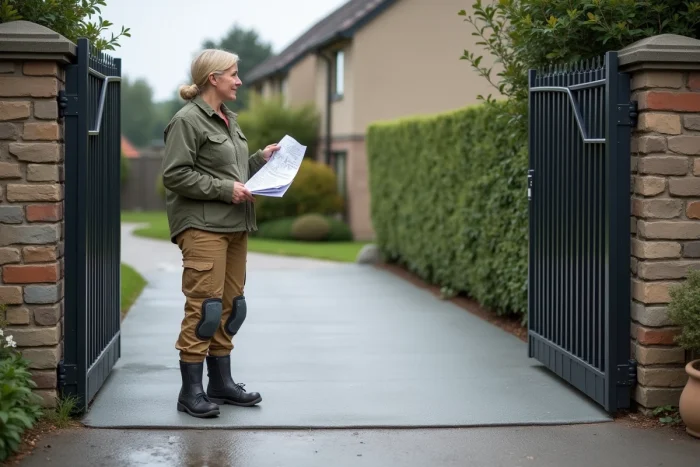
A gate threshold often incorporates a slight slope for rainwater drainage. Self-leveling compound, by definition, seeks the horizontal. On an inclined surface, it is therefore necessary to use a thixotropic product (which does not flow on slopes) or resort to formwork to maintain the desired drainage profile.
Ignoring this constraint creates stagnant puddles in front of the gate, which accelerate the erosion of the freshly renovated threshold and promote freezing in winter.
Cracks, sagging, erosion: identifying the cause before repairing the threshold
Leveling a cracked threshold without addressing the root cause of the disorder is akin to masking the problem. The most common causes are differential settling of the soil beneath the slab, the absence of reinforcement in the original threshold, or insufficient drainage that saturates the supporting ground.
A crack that reappears after repair signals a foundation issue, not a surface defect. In this case, the only sustainable intervention consists of excavating, compacting the soil, placing welded mesh, and pouring a new slab at a sufficient thickness.
Surface erosion, on the other hand, can be effectively treated with self-leveling compound if the underlying support remains sound. The test is simple: strike the concrete with a hammer. A hollow sound indicates internal delamination, while a solid sound confirms that the self-leveling compound can adhere.
The choice between superficial repair and structural repair determines the longevity of the renovated threshold. An honest diagnosis of the support, even if it leads to heavier work, avoids having to redo the project two years later.