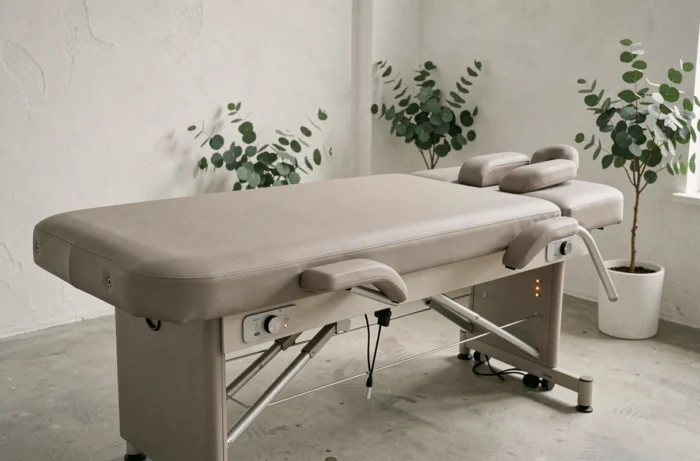
A massage table is primarily defined by its ability to withstand repeated mechanical stresses while allowing the practitioner to work without injury. Recent developments focus less on adding gadgets and more on solving concrete problems: stability under dynamic load, adaptation to the therapist’s morphology, and balancing weight and robustness for mobile practitioners.
Dynamic Stability of a Massage Table: Beyond the Maximum Weight Advertised
Product sheets display a maximum static load, often expressed in hundreds of kilograms. This figure is reassuring, but it does not describe what happens during a deep massage or assisted stretching.
The dynamic load corresponds to the forces exerted when the practitioner applies their body weight on a moving client. During a firm kneading of the lower back, the table experiences simultaneous lateral and vertical thrusts. A stable model when empty can oscillate significantly as soon as one works with high pressure on a large client.
To assess this stability, the table must be tested under real conditions: applying sustained pressure on an edge, simulating an assisted stretch, and checking that the feet do not slip on a smooth floor. Stability is measured during a protocol, not on a technical sheet. Manufacturers who reinforce the central crossbars and widen the foot stance directly address this need, even if it adds weight.
To explore the latest news on La Table De Massage, this distinction between static load and dynamic load serves as a useful selection filter before any purchase.
Height Adjustment According to the Therapist’s Morphology
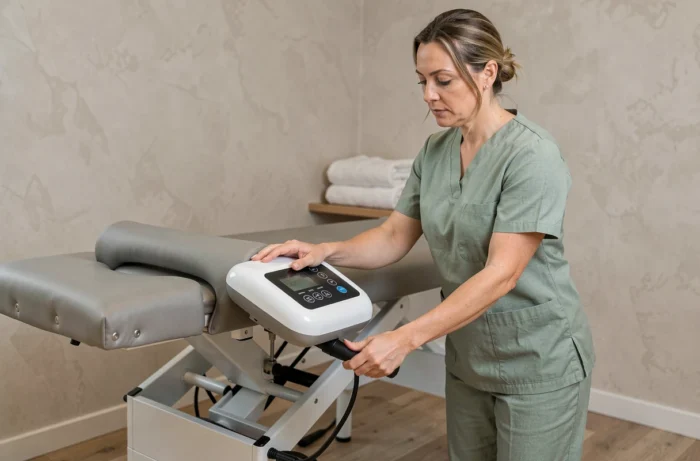
Most buying guides present height adjustment as a comfort criterion for the client. In reality, the table height primarily protects the back and shoulders of the therapist.
Recent ergonomic recommendations suggest an adjustment range covering approximately 24 to 35 inches. This range allows both a short practitioner and a therapist measuring over one meter ninety to work without excessive bending of the back or wrist strain.
What Adjustment Changes in Daily Practice
A therapist who performs six sessions a day at an improperly calibrated height accumulates microtraumas in the shoulders and lower back. A review published in the International Journal of Therapeutic Massage and Bodywork noted that the practice of massage exposes the therapist to a heavy physical load and significant postural risks.
Hydraulic or electric adjustment during the session changes the game. The table is lowered for deep back kneading (the body weight replaces arm strength), then raised for precise cervical drainage. Adjusting the height to the technical gesture tangibly reduces joint fatigue over a full day.
Testing a Massage Table Under Real Conditions Before Purchase
Comparing product sheets is not enough. A table is judged in situation, with a structured protocol that reproduces everyday constraints.
- Lateral pressure stability: ask a colleague to lie down while the practitioner applies oblique pressures on the sides of the table, checking for any tipping or squeaking of the joints.
- Transport and repeated assembly: fold and unfold the table ten times in a row, carry it over a realistic distance (a hallway, a staircase), time the setup. A model that takes more than two minutes to set up slows down a practitioner moving between appointments.
- Height adjustment under load: change the height while a client is lying down. Some hydraulic mechanisms struggle under load, requiring the client to get up.
- Comfort of padding after an hour: padding that feels soft for five minutes can compress and create pressure points after a full session. Test over the actual duration of a treatment.
Portability and Robustness: A Trade-off to Quantify
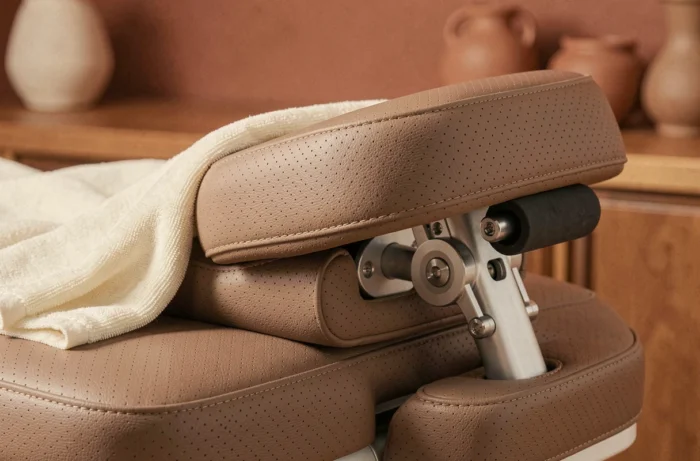
Aluminum tables appeal due to their lightness. They are suitable for practitioners who move daily with their equipment. However, for a fixed practice offering high-pressure treatments or accommodating large clients, a solid wood or reinforced steel frame provides significantly superior stability.
This trade-off depends on the primary use. A practitioner who splits their activity between an office and home visits may benefit from owning two tables rather than a single compromise that does not satisfy either context.
Specialized Tables by Type of Treatment: A Growing Segmentation
Recent sources confirm a trend toward specialized design. Manufacturers increasingly separate ranges according to three distinct usage profiles: mobile practitioner, fixed spa, and clinic practicing intensive techniques.
A table intended for shiatsu does not have the same constraints as a lymphatic drainage table. The former must withstand strong vertical pressures with a wide, low platform. The latter prioritizes an adjustable backrest and softer padding for long sessions.
Choosing a table based on the technique practiced rather than a generic category (portable, fixed, electric) better guides the investment. Practitioners who diversify their treatments benefit from ensuring that the chosen table meets the demands of their most rigorous protocol.
Future Market Insights estimates the spa massage table market at $130.8 million in 2026, with a projection of $193.6 million in 2036 and an average annual growth rate of 4%. This growth is driven by the opening of facilities in Southeast Asia and the Gulf, as well as equipment renewals in Europe and Japan.
Analyst Rahul Pandita emphasizes that the profitability of a table is measured by the number of services it allows. The most useful angle for a purchase remains that of testing under real conditions, with a real protocol, a real client, and the logistical constraints of daily life.