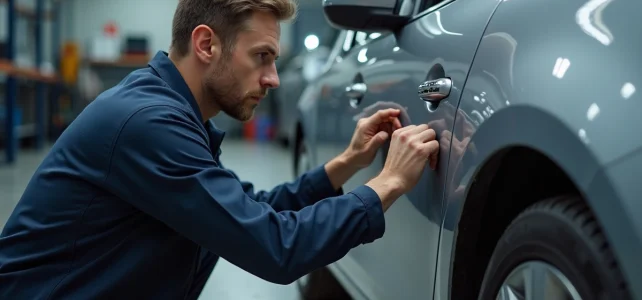
On a Peugeot 308, when the central locking stops responding, it often happens on a rushed morning, key in hand, and nothing happens. The beep works from the dashboard, but the remote remains silent. We change the battery, attempt a reset, and the problem persists. This scenario is common among the majority of owner feedback, across all generations.
Peugeot 308 Central Locking Failure: The Role of the BSI Above All
Before disassembling anything, it’s worth checking the BSI (intelligent service box) to save time. This module manages almost all electrical functions of the 308: lighting, wipers, alarm, and of course, central locking.
When the BSI malfunctions, the symptoms can be misleading. One door locks but not the others. The trunk remains inactive while the alarm triggers normally. One might think it’s a mechanical lock issue, while the failure is often software-related.
Feedback published since 2023 on 308 GTIs and high-end trims shows a correlation between BSI updates from Peugeot and the lasting disappearance of these central locking bugs (doors reopening by themselves, inactive trunk). In other words, a telecoding or reprogramming of the ECU sometimes resolves the issue without changing a single part. A complete diagnosis of solutions to the Peugeot 308 central locking problem details these software causes.
A mechanic equipped with a PSA-compatible OBD2 diagnostic tool can read the fault codes stored in the BSI and determine if a reprogramming is sufficient. Without this tool, one ends up going in circles.
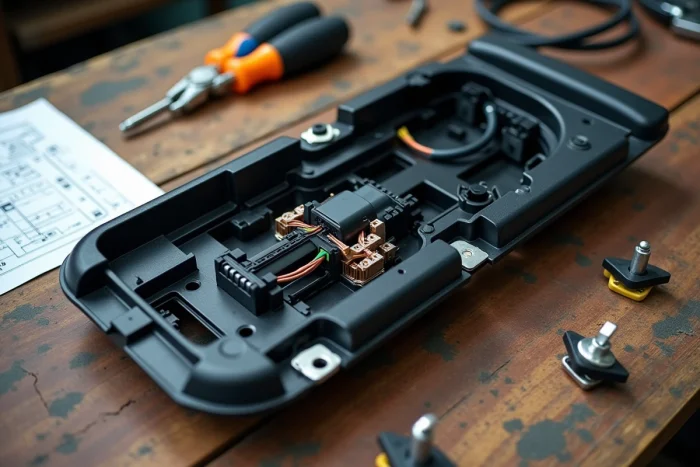
Wiring Harness and Lock Motor: Hardware Failures Not to Overlook
When reprogramming makes no difference, the problem lies downstream of the BSI. Two components account for the majority of hardware failures on the 308.
The Wiring Harness in the Doors
The passage between the body and the door is a zone of constant flexing. With each opening and closing, the wires bend. After several years, a broken wire in the harness cuts the signal to the lock motor, even if the rest of the system functions.
The diagnosis is simple in theory: test the electrical continuity wire by wire with a multimeter. In practice, one must remove the door panel and partially pull out the harness. On first-generation 308s (ten years and older), this is the most common cause when a single door refuses to lock.
The Lock Motor (Actuator)
Each door has a small electric motor that physically operates the lock. These motors wear out, especially on the driver’s door, which is used much more than the others. The typical symptom: a sharp clicking sound with no movement of the lock, or a grinding noise followed by a blockage.
Replacing a lock actuator remains a manageable task for an independent mechanic. Feedback varies on the exact cost, but it’s significantly less expensive than a complete BSI replacement.
Key Reset and Fuse Check: Basic Steps
Before embarking on costly repairs, a few quick checks can eliminate the simplest causes:
- Replacing the remote battery: a weak battery reduces the signal range to the point of requiring almost direct contact with the lock cylinder to function, a symptom documented on 308 SW owner forums.
- Key reset: turn on the ignition, press the lock button immediately for about fifteen seconds, then remove the key. This procedure resynchronizes the remote with the vehicle’s receiver.
- Check the fuses related to central locking: a blown fuse or a poor connection at the fuse box cuts power to the locking system. One can also swap two fuses of the same amperage to quickly check if one of them is faulty.
If central locking works from the interior dashboard button but not from the key, the problem lies between the remote and the receiver, not in the locking circuit itself.

Repair Costs and Coverage: What Has Changed Since 2023
Independent mechanics have reported since 2023 an increase in partial coverage refusals by Peugeot for central locking failures on 308s older than five or six years. The “commercial gestures” on the BSI, lock motors, or harnesses, which were more common a few years ago, are becoming increasingly rare for vehicles out of warranty.
This evolution directly impacts owner choices. In the used car market, listings for first-generation 308s increasingly mention partially inoperative central locking, left as is. Some owners manually close one or more doors rather than engage in repairs that exceed the vehicle’s residual value.
Platforms connecting customers with garages now show a specific line item for diagnosing and repairing central locking on 308s in their recent pricing grids. Comparing quotes between the Peugeot network and independent mechanics remains the most cost-effective approach, especially for interventions on the BSI that require a compatible diagnostic tool.
For a 308 still in generally good condition, reprogramming the BSI or targeted replacement of a lock actuator extends the vehicle’s lifespan at a reasonable cost. For a heavily worn model, the question deserves to be asked frankly before incurring expenses.