Several companies in France’s tree-pruning sector operate under the name Winterstein, with distinct SIRET numbers and different service areas. Before signing a quote, the question is not whether the company “exists,” but what it actually covers: its legal status, the insurance policies it holds, and whether the work complies with regulations. This article reviews the measurable criteria that distinguish a reliable contractor from an inadequately supervised operator.
Tree-pruning insurance: coverage to request in writing
Professional liability insurance is not a legal requirement for every business activity in France. A tree surgeon can therefore work without it. That is precisely why it is essential to check before any work begins.
Depending on the nature of the work, three types of coverage may apply. The insurance certificate requested from the company must explicitly state what it covers, not merely list a policy number.
| Type of coverage | What it covers | Mandatory? |
|---|---|---|
| Professional liability insurance | Damage caused to third parties (neighbours, property, people) | Not mandatory for all business activities |
| Ten-year liability insurance | Construction activities covered by law | Yes, for the relevant work |
| Specific site insurance | Risks associated with the site (power lines, adjoining buildings) | Depending on the site layout |
A quote that does not mention the company’s insurance coverage is a warning sign. Ask for a certificate that specifies the actual scope of coverage, not a generic document. A contractor who refuses to be transparent offers no protection if your property or a neighbour’s is damaged.
The detailed information in the article on Winterstein tree pruning notes that several separate businesses operate under this name, each with its own insurance policies.
The tree surgeon’s SIRET number and legal status: what an online check can reveal
A trading name alone is not enough to identify a tree-pruning company. At least three different entities operate under the name Winterstein. Kael Winterstein operates under SIRET 920 125 077 00023, for a business established in October 2022. David Winterstein is registered under SIREN 881 758 650 and based in Sarcelles. A third business, spelled “Winsterstein Elagage,” operates in Caudebec-lès-Elbeuf in département 76.
Confusing these entities can directly affect the validity of the signed quote. A contract issued in the name of a business whose SIRET number does not match the company carrying out the work can create legal problems in the event of a dispute.
- Check the company record on the national business register website to confirm that the SIRET number is active and has not been struck off.
- Make sure the registered office address matches the service area advertised by the contractor.
- Compare the exact name on the quote with the name on the register: even a one-letter difference may indicate a separate entity.
An active SIRET number does not guarantee technical competence, but a non-existent or struck-off SIRET number immediately disqualifies the contractor. This is the first check to make, before even discussing the price.
Tree-pruning regulations and nesting season: local restrictions to plan for
The period from 16 March to 15 August is often presented as a blanket ban on tree pruning. The reality is more nuanced. This period relates in particular to agricultural cross-compliance rules and is not, in itself, a nationwide ban that applies to all private individuals.
However, protections for species, nests and breeding sites may require precautions regardless of the date. A tree surgeon who schedules work in April without mentioning this restriction is either unaware of the legal framework or choosing to ignore it.
Special case of hedges under the law of 24 March 2025
The Agricultural Guidance Act of 24 March 2025 changed the rules governing hedges. Their removal is now subject to a single prior declaration procedure, with authorisation required in certain cases. Nesting-season dates may be specified by a prefectural order.
A quote for hedge work is therefore not enough to establish that the work is authorised. The company must be able to say whether a prior declaration has been submitted or is required. Failing to mention regulatory requirements in a hedge-trimming quote constitutes a breach under this reform.
What a tree-pruning quote should include: details that set professionals apart
Price is not the most telling factor when comparing two quotes. The level of detail matters more. A complete tree-pruning quote should specify the exact work to be carried out: light pruning, reduction pruning, felling or stump removal. A vague description such as “tree pruning,” with no technical details, does not make clear what will actually be done.
In addition to describing the services, a quote should include several other details:
- How green waste will be removed (included or charged as an extra), and where it will be taken.
- How long the quote is valid for—30 days unless otherwise stated, according to the general terms and conditions of some Winterstein companies.
- Travel costs, listed separately from the cost of the work.
- The SIRET number of the company that will actually carry out the work.
A detailed quote protects both the client and the contractor if there is a disagreement about the scope of the work. Acceptance is confirmed by signing after the words “Approved,” either on paper or electronically.
Technical qualifications and equipment
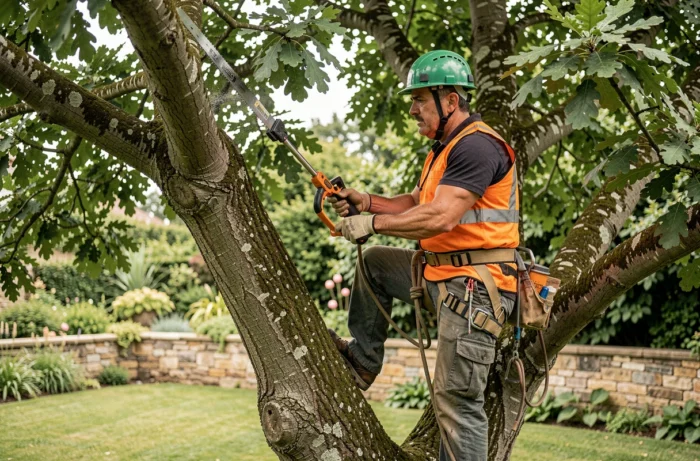
A professional working at height must have suitable personal protective equipment and be proficient in climbing or using a cherry picker. Working near power lines requires compliance with regulated safety distances, which only a trained operator can maintain.
Specialist certifications (such as a certificate of specialisation in tree pruning and care) are not legally required, but they demonstrate a verifiable level of competence. Asking about qualifications before requesting a quote helps avoid unpleasant surprises once work is underway.
Choosing a tree-pruning contractor should be based on verifiable details: an active SIRET number, a detailed insurance certificate, a precise quote that includes regulatory information, and documented qualifications. All of these checks can be made before signing—not after the first chainsaw cut.