
In France, cities that are home to universities and grandes écoles do more than attract students for the duration of their studies. They are also drawing an increasing share of young professionals and mid-career workers.
According to Insee, higher education institutions attract young adults, while the availability of skilled jobs encourages them to stay after graduating. This two-stage process—education followed by employment—shapes an urban landscape where student and professional life overlap.
The local economic impact of universities on employment areas
Universities are often seen simply as places of learning. But their impact on the local economy goes far beyond the recruitment of graduates by nearby businesses.
An impact study published by the University of Poitiers in July 2025 describes the economic benefits generated by staff salaries, the institution’s purchases from local suppliers, and students’ day-to-day spending. These flows support retail, restaurants, housing and local services. For a professional moving to the area, this means a denser network of small and medium-sized businesses and service providers than in a similarly sized city without a campus.
This virtuous circle attracts companies looking for both newly trained talent and a well-developed service economy. Orléans, for example, has been pursuing a strategy for several years to expand its higher education offering, raise the region’s skill levels and, in turn, attract employers.
Understanding why university cities appeal to professionals means looking beyond lecture halls: it is the entire chain, from research labs to industrial subcontractors, that creates local jobs.
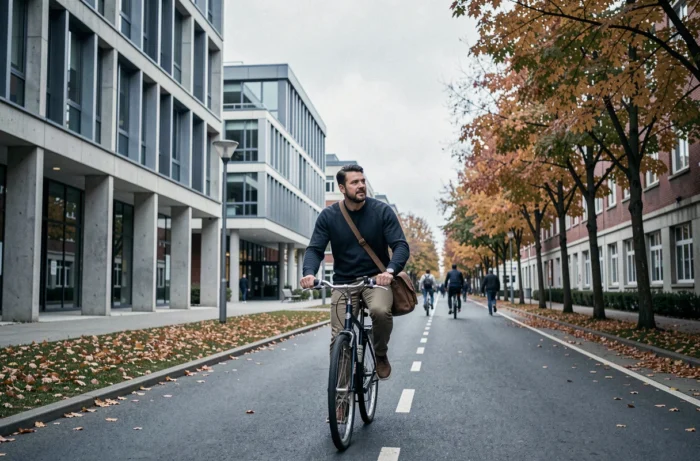
Mid-sized university cities and major metropolitan areas: where do graduates settle?
Insee notes that 30 cities are home to three-quarters of metropolitan France’s students aged 18 to 24. After graduation, their paths diverge. Some young adults move to major economic hubs, with Paris the leading destination. Others stay in the city where they studied, provided they can find a job suited to their field.
A degree helps people enter the workforce, but it does not erase the differences associated with their field of study. In 2024, Insee reported higher unemployment among recent graduates than among those who had left education earlier, with marked differences by field. A computer engineer trained in Rennes faces different prospects from a literature graduate from the same city.
Mid-sized university cities have a particular advantage here. They offer a lower cost of living than major metropolitan areas, shorter commutes and, in some cases, easier access to housing. For businesses, setting up in a mid-sized city with a campus makes it possible to recruit locally without competing head-on with Paris-level salaries.
What professionals are actually looking for in these cities
- An employment area supported by university research and partnerships between labs and local businesses, creating skilled jobs in niche sectors
- A cultural and community scene partly driven by the student population (performance venues, festivals and nightlife), bringing a rare level of vibrancy to cities of this size
- Transport infrastructure designed to serve a campus, which also benefits professionals (trams, frequent bus services and, in some cities, TGV stations)
- A supply of student rentals that, thanks to its scale, helps keep private-market rents lower in nearby neighborhoods
Housing and cost of living: the hidden side of student appeal
A university city’s appeal to professionals also rests on a paradox. Student demand sustains the rental market, but it can also create pressure.
The Observatoire de la vie étudiante found that students reported more financial difficulties in its 2023 survey than in 2020. Student hardship has knock-on effects: some students are pushed into substandard housing or unwanted house shares, artificially sustaining demand for small apartments. For professionals at the start of their careers, competition for studios and one- or two-bedroom apartments can make finding a place to live harder than expected.
Local authorities that invest in purpose-built student residences automatically free up housing in the private market. Several mid-sized cities have identified this as a way to ease pressure, but it can take years for the effects to materialize.

Can a university city remain attractive as its student population declines?
This question is arising in several French cities where student numbers have stagnated or fallen. A decline in student numbers weakens the entire local economic chain, from neighborhood businesses to private landlords. For professionals already living there, this can mean fewer cultural offerings, reduced transport services and, over time, a shrinking employment base.
Some cities are getting ahead of this risk by diversifying their education offerings. Attracting private schools, satellite campuses of grandes écoles or continuing education centers can help maintain a flow of young, skilled residents, even as the national population of 18- to 22-year-olds declines.
The challenge is no longer just to attract students, but to retain the professionals who emerge from their ranks. Local policies that combine education, support for business creation and investment in mid-market housing tend to achieve better results than those focused solely on academic prestige. The relationship between a university and its region now depends on its ability to turn students into long-term residents.