
Costume jewelry is not just about aesthetic choice. Behind the visible trends (layering, saturated colors, sculpted volumes), the quality of a piece primarily depends on its chemical composition and regulatory compliance. It is this technical foundation that determines whether a piece of costume jewelry retains its shine after several months or causes a skin reaction within the first week.
Nickel Release and REACH Standards: What the “Nickel-Free” Label Hides
The “nickel-free” label on a product sheet does not guarantee anything by itself. The REACH regulation governs the amount of nickel released upon prolonged contact with skin: the limit is 0.5 µg/cm² per week for jewelry worn against the skin, and 0.2 µg/cm² for items inserted into a pierced area (earring posts, piercings).
Controls rely on the EN 1811:2023 standards to measure the release rate and EN 12472:2020 for pieces coated with plating. Recalls of non-compliant jewelry continue in Europe despite the age of these rules. This means that a low-quality gold or silver coating can allow nickel to migrate as soon as the protective layer wears off, sometimes within a few weeks of daily wear.
We recommend checking with the manufacturer or distributor if the pieces have been tested according to these two standards, and not simply declared “hypoallergenic” without documentation. Catalogs like the one offered on bijouxdange.com allow you to identify creations that detail the composition of their alloys and the type of plating used.
GPSR Regulation and Traceability of Costume Jewelry Sold in the EU
Since December 13, 2024, the General Product Safety Regulation (GPSR) applies to jewelry marketed in the European Union. This text transforms compliance into a matter of design and traceability, not just a marketing argument.

In practical terms, professionals must integrate a risk analysis from the design phase and maintain technical documentation demonstrating product safety. For independent creators and small costume jewelry brands, this means being able to provide:
- The technical sheet of the alloys used (composition, origin, test certificates)
- The compliance report with nickel, lead, and cadmium release standards
- A traceability system allowing identification of each batch in case of a recall
The GPSR makes technical documentation a purchasing criterion, not just an administrative formality. Costume jewelry sold without this traceability exposes the retailer to sanctions and the consumer to an unquantified health risk.
Costume Jewelry Trends: Rising Shapes and Materials
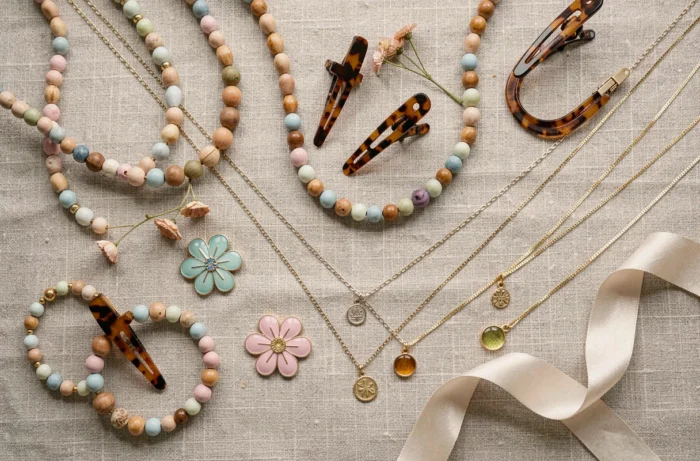
Layering remains the dominant grammar of the season. It is observed on necklaces (chokers paired with chains of varying lengths), bracelets, and rings worn on multiple fingers. Accumulation works as long as a color coherence is respected: gold on gold, or an accepted gold-silver mix if the pieces share a common motif.
In terms of materials, stainless steel is gradually replacing plated brass in the sustainable costume jewelry segment. Its resistance to oxidation makes it suitable for daily wear without quick tarnishing. Handwoven Miyuki beads also maintain their place for bracelets, driven by the demand for artisanal and colorful pieces.
Earrings: Sculptural Volume and Asymmetrical Formats
This season’s costume earrings play with volume. Thick hoops, geometric drops, oversized formats: the ear jewelry becomes the centerpiece of the look, often worn alone (a statement earring on one side, a discreet stud on the other).
Cut leather and uncalibrated natural stones are increasingly appearing in designers’ collections, bringing an organic texture that metal alone does not offer.
Necklaces and Rings: The Return of Naturalistic Motifs
Floral motifs, foliage, and animal shapes are widely circulating. The trend is not new, but it stands out due to the treatment: matte finishes, relief volumes, colored enamels rather than simple engravings. Rings accumulate on the hand, mixing fine pieces with a more substantial signet ring.
Maintenance of Costume Jewelry: Actions that Extend Lifespan
The longevity of a piece of costume jewelry depends as much on its maintenance as on its manufacturing. A gold or silver plating deteriorates with repeated contact with water, perfume, sweat, and cosmetic products.
- Remove jewelry before showering, exercising, and applying cream or perfume
- Store each piece separately in an individual pouch to avoid friction between metals
- Clean with a dry microfiber cloth after each prolonged use
- Avoid abrasive cleaning products (baking soda, toothpaste) on plated pieces
A well-maintained piece of costume jewelry retains its shine for several seasons. Conversely, a plating exposed daily to moisture can deteriorate within weeks, regardless of the initial purchase price.
The choice of a piece of costume jewelry relies on three criteria rarely found together in the same product description: verifiable regulatory compliance, quality of the plating or alloy, and alignment with a clearly defined personal style. Trends come and go, but a piece with transparent composition remains wearable well beyond a season.