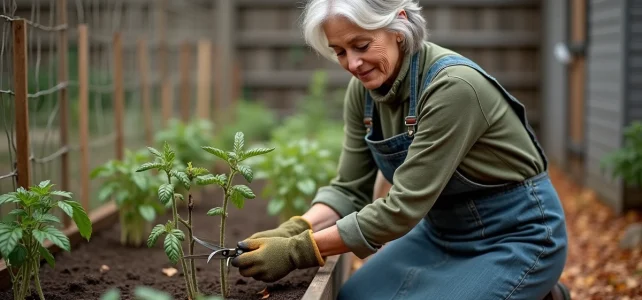
The annual maintenance of a vegetable garden is not just about weeding and watering. It involves a series of technical actions, from soil work to water management, where the order and timing directly affect the quality of the harvests. Each step prepares the next one, and a timing error in any of them impacts the entire growing season.
Soil Fertility in the Vegetable Garden: Diagnosis Before Any Additions
Before adding compost or an amendment, it is essential to know what the soil already contains. Research from INRAE on urban and peri-urban garden soils shows a trend of decreasing organic matter content and increased compaction, linked to soil compression and a lack of regular organic inputs. Amending compacted soil without first loosening it is like feeding a plant that cannot absorb nutrients.
The first step in the annual maintenance of the vegetable garden is therefore to assess the soil structure. Take a handful of moist soil and squeeze it. If it forms a compact ball that does not crumble, the soil is too clayey or compacted. If it disintegrates immediately, the organic matter content is likely insufficient.
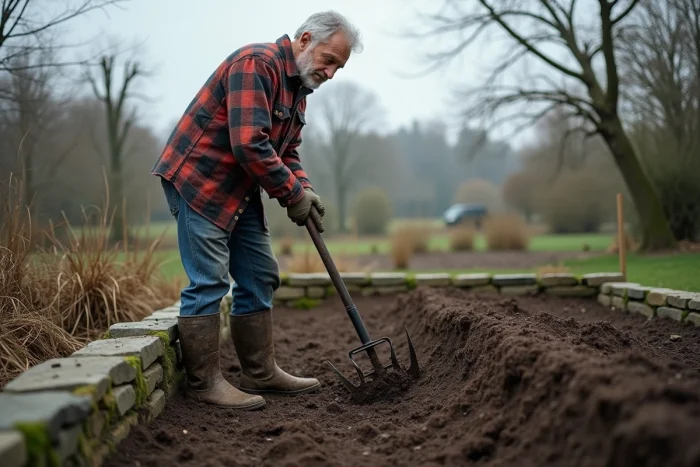
A productive vegetable garden soil relies on a balance between aeration and water retention. Using a broad fork on the growing beds, without turning the layers, is enough to revive biological activity. It is only after this step that adding mature compost or composted manure makes sense, by applying reasoned fertilization advice on Clic Garden tailored to the type of soil.
Water Restrictions and Vegetable Garden Watering: Anticipating Drought
Since 2022-2023, several French departments have been under drought alert each summer with watering bans at certain times or by certain systems. The Ministry of Ecological Transition and the French Biodiversity Office recommend anticipating these episodes from the design of the vegetable garden. Ignoring this parameter risks losing seedlings in the height of summer due to the inability to hydrate them.
Reduce the Area to Water
The most effective strategy is to concentrate crops in narrow, mulched beds. A bed 1.20 m wide, bordered by uncultivated paths, allows for watering only the root zone without wasting water on the pathways. Organic mulching (straw, hay, branch chippings) maintains soil moisture and limits evaporation.
Store Rainwater and Choose the Right System
Installing a rainwater reserve sized for the cultivated area changes the game. Drip irrigation delivers water directly to the base of the plants, reducing consumption compared to a traditional watering can. Combined with a timer, this system allows for early morning watering when evaporation is minimal.
- Favor varieties of vegetables that are tolerant to water stress (small heirloom tomatoes, dwarf beans, local squashes) to limit water needs.
- Mulch each bed with a sufficient thickness so that the soil remains cool to the touch under the mulch layer, even in full sun.
- Check the prefectural orders for water restrictions before the planting season, as they may prohibit the use of network water for irrigation.
Sowing and Planting Calendar: The Right Action at the Right Time
A successful annual maintenance relies on a sowing calendar adapted to the region. Sowing tomatoes outdoors before the last frosts means losing plants. Waiting too long shortens the fruiting period.
Indoor sowing starts in late winter for long-cycle vegetables (tomatoes, peppers, eggplants). Transplanting outdoors occurs once the risk of frost has passed, generally between mid-April and mid-May depending on the climatic zone. Short-cycle vegetables (radishes, salads, beans) are sown directly in place as soon as the soil reaches a stable temperature.
Crop Rotation in the Vegetable Garden
Planting the same vegetables in the same spot year after year depletes the soil of specific nutrients and encourages disease establishment. Crop rotation over three or four years involves alternating botanical families in each bed: fruiting vegetables (tomatoes, zucchinis), leafy vegetables (salads, spinach), root vegetables (carrots, beets), and then legumes (peas, fava beans) that fix atmospheric nitrogen and regenerate the soil.
A gardening notebook or a simple plan drawn each year is enough to track this rotation. The benefits are measured over time: more vigorous plants, fewer treatments, and soil that remains alive.
Natural Protection Against Pests in the Vegetable Garden
Annual maintenance includes managing pests without systematically resorting to chemical products. Plant associations are an underutilized lever. Basil planted at the foot of tomatoes repels certain insects, while marigolds limit the proliferation of nematodes in the soil.
A diverse vegetable garden attracts beneficial insects (ladybugs, hoverflies, lacewings) that naturally regulate aphid populations. Leaving a flowering strip at the edge of the garden or installing an insect hotel contributes to this balance. The anti-insect net placed over cabbages and carrots remains the most reliable physical barrier against the cabbage moth and carrot fly.
- Inspect the plants weekly to spot the first signs of attack (chewed leaves, mucus traces, discoloration).
- Manually remove larvae and gastropods rather than treating on a large scale.
- Alternate plant families from year to year to break the cycle of specialized pests.
The maintenance of a vegetable garden relies more on the regularity of actions than on their complexity. A well-diagnosed soil, watering adapted to local restrictions, a respected sowing calendar, and consistent biological protection form a stable foundation. The rest is the weekly observation of each bed, as no guide can replace the eye on one’s own crops.