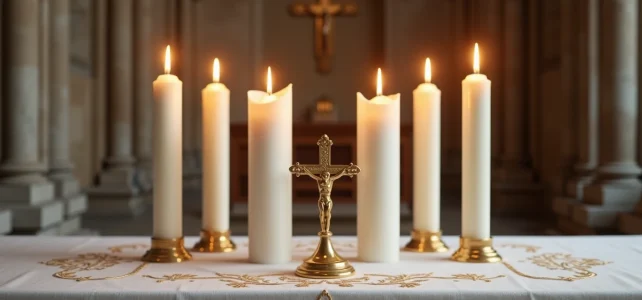
Six lit candles on either side of an altar cross: the scene is familiar in Catholic churches, but the significance of this precise number is much less well-known. The Roman liturgy does not always prescribe six candles. The official rubrics require at least two for a regular Mass, and only increase this number for solemn or pontifical celebrations.
Understanding why the number six has become common practice involves distinguishing between what pertains to liturgical norms, local tradition, and catechetical interpretation.
What the liturgical texts actually prescribe about altar candles
The idea that six candles are mandatory at every Mass is widely held. However, it is inaccurate. The Institutio Generalis Missalis Romani, in its typical edition from 2002 still in effect, sets a much more flexible framework.
For a regular Mass, two candles are sufficient. The number increases according to the degree of solemnity of the celebration, reaching six for the most solemn Masses, and even more when the bishop presides.
The transition from two to six candles thus reflects a degree of solemnity, not a universal obligation. Many parishes have adopted six candlesticks in a permanent arrangement, which has gradually erased the distinction between ordinary and solemn celebration in the perception of the faithful.
The instruction Redemptionis Sacramentum (2004) from the Congregation for Divine Worship provides additional clarification: the visibility of the cross and the altar takes precedence over the number of candles. The arrangement should serve the readability of the rite, not a decorative effect. An article detailing the tradition of candles on the altar on Univers Mariage revisits the various interpretations associated with this arrangement.
Six candles on the altar: where does this number come from in Catholic tradition
Since the norm does not systematically impose six flames, the question shifts: how did this number become widespread in Latin churches? The answer lies at the intersection of liturgical history and popular catechesis.
A practice born in the Middle Ages, then standardized
The early centuries of Christianity did not set any rules regarding the number of lights. Candles initially served a practical function: to illuminate often dark places of worship.
It was during the Middle Ages that the arrangement of six candlesticks around the altar cross became institutionalized in cathedrals and large abbeys. The codification of the Roman rite then formalized this practice for the solemn Mass. Six candlesticks symmetrically arranged on either side of the cross became the visual norm for altars. This configuration remains associated with the extraordinary form of the Roman rite.
Catechetical interpretations of the number six
Several spiritual readings have been attached to this arrangement over time. None constitute an official doctrine, but some recur in parish teaching:
- The six days of Creation, with the light of an additional candle (sometimes added during the Mass presided over by the bishop) representing divine rest or the presence of the risen Christ.
- A reminder of the theological and cardinal virtues, although their total number (seven) does not correspond to six, which weakens this interpretation.
These readings fall under a local catechetical usage rather than a doctrinal norm. Their very diversity confirms that no single explanation has gained prominence in the magisterium.
Candle and light in the liturgy: beyond the number
Focusing on the number six obscures what the flame itself signifies within the liturgical context. The light of the candle refers to the presence of Christ, referred to as “the light of the world” in the Gospel texts.
The paschal candle illustrates this symbolism more directly than altar candles. Lit during the Easter vigil and kept visible throughout the Easter season, the flame of the paschal candle signifies the resurrection of Christ. Its light is passed on to the faithful at the beginning of the vigil.
Altar candles function differently. They signal the sacredness of the place of celebration and accompany prayer. Their traditional material, beeswax, also carried symbolic weight in ancient catechesis.
Current arrangement and practical criteria
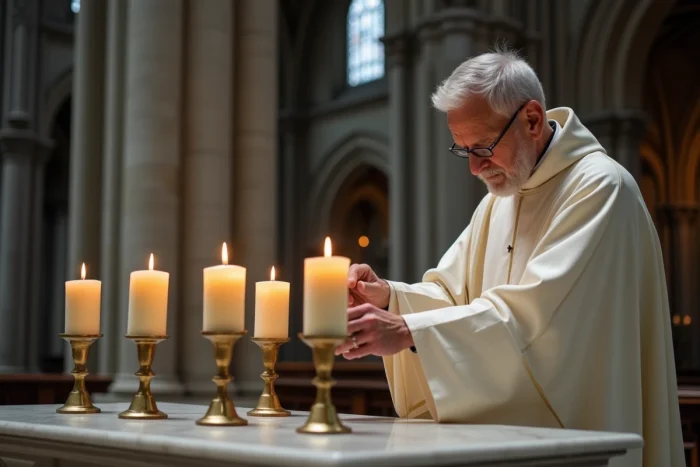
Since the liturgical reform that followed the Second Vatican Council, the arrangement of candlesticks has responded to more functional criteria. Recent documents require that the altar’s layout promotes visual harmony and active participation of the faithful.
Some parishes place the candles on the altar, while others arrange them around, on floor candlesticks. The choice depends on the size of the altar, the architecture of the sanctuary, and the visibility desired for the cross. The goal remains that nothing obstructs the view between the assembly and the place of the Eucharistic sacrifice.
Wedding candles and Mass candles: a frequent confusion
During wedding ceremonies in the church, the six candles are sometimes perceived as a decorative element. This reading overlooks their liturgical function. Altar candles are not chosen by the couple: they are part of the permanent liturgical furnishings.
The candle that the couple lights together (often called the “unity candle”) is a completely different object, which does not fall under the tradition of the Roman liturgy. Confusing altar candles with decorative candles amounts to mixing two registers: one belongs to the Church’s liturgy, the other to the personal staging of the ceremony.
The presence of six candlesticks during a wedding celebrated during a solemn Mass does not indicate anything particular about the sacrament of marriage. It indicates the degree of solemnity of the Eucharistic celebration itself. It is the Mass that is solemn, not the marriage as such.
The number of candles on the altar remains primarily a liturgical marker. Six flames around the cross reflect a medieval heritage that has become a visual norm, without the number carrying a universal doctrinal significance. The light, however, retains its symbolic meaning in all cases: it signals the divine presence at the heart of the celebration.