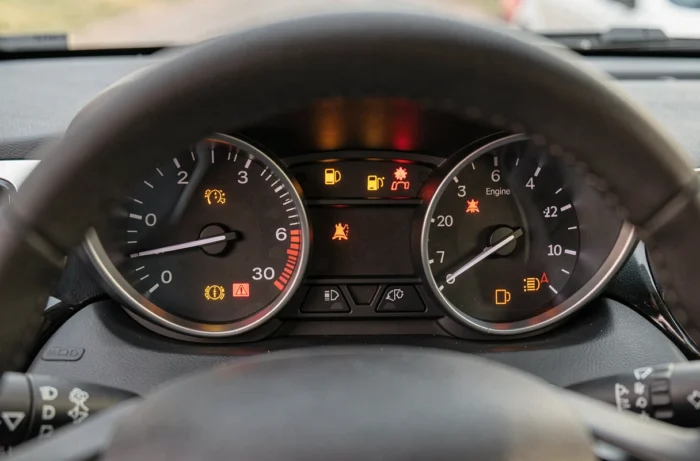
On a Peugeot 208, the dashboard can display several dozen different warning symbols depending on the generation (208 I, 208 II), the engine type (PureTech, BlueHDi, e-208), and the equipment level. Knowing how to read these indicators means understanding that not all signal a problem: some simply confirm that a function is active, while others require an immediate stop of the vehicle.
Specific indicators based on the engine type of the Peugeot 208
The instrument cluster does not show the same indicators on a petrol, Diesel, or electric 208. A driver transitioning from a PureTech to an e-208 discovers symbols they have never seen before, and vice versa.
| Engine Type | Specific Indicators | Absent on Others |
|---|---|---|
| PureTech (petrol) | Engine warning light (injection/ignition), catalyst alert | No AdBlue indicator or charging cable |
| BlueHDi (Diesel) | AdBlue indicator, particulate filter (DPF), preheating | No traction battery indicator |
| e-208 (electric) | Charging cable, turtle mode, high voltage battery, high voltage circuit isolation alert | No traditional engine oil light or DPF |
This difference makes any generic list incomplete. The official manual corresponding to the exact model year and VIN remains the reference for identifying each symbol. To browse a list of Peugeot 208 dashboard indicators categorized by type, a dedicated guide allows you to cross-reference color, symbol, and engine type.

Self-test at startup and false positives on the dashboard
Turning the key or pressing the Start button causes several red and orange lights to illuminate simultaneously. This behavior is normal: the computer checks each circuit (braking, airbag, ABS, engine, power steering) before turning them off one by one.
A warning light that remains on after starting indicates a real fault. Confusion between self-test and persistent alert is one of the most common mistakes. If a red light does not disappear within seconds of starting, the vehicle should not be driven until checked.
On the e-208 in particular, a fault detected in the high voltage circuit can go beyond a simple warning light. A preventive cut in engine torque may occur, drastically reducing available power. The UK DVSA safety campaign R/2024/176 identified an issue with incorrect detection of insulation loss in the high voltage circuit, corrected by free software reprogramming at an authorized repairer.
Engine warning light on PureTech: timing and recall campaigns
The orange engine warning light on a 208 PureTech deserves special attention. Its illumination may signal an injection, combustion, or emissions issue, but also a malfunction related to the timing.
The type of timing varies depending on the version of the 1.2 PureTech engine. The most recent versions use a timing chain, while some earlier or intermediate configurations retain a belt submerged in oil. This belt has been reported repeatedly for premature wear.
- Eligibility for a recall or coverage campaign depends on the VIN and production configuration, not just the model year or commercial name
- A persistent engine warning light on a PureTech equipped with an oil-bath belt warrants a quick diagnosis, as a belt failure can lead to engine destruction
- Decoding the VIN (via the manufacturer’s website or an online tool) allows you to check if the vehicle is part of a recall batch
Ignoring an orange engine warning light on these engines by thinking it is just a faulty sensor can cost the price of a complete engine.
Red warning lights on the Peugeot 208: hierarchy of mechanical risks
Not all red warning lights imply the same level of mechanical severity. Oil pressure and engine temperature are the two most destructive alerts if ignored, as they indicate a risk of internal failure within minutes.
Oil pressure and engine temperature
The oil pressure warning light (symbol of a can) indicates that engine lubrication is no longer ensured. Continuing to drive in this situation causes seizing. The temperature light (thermometer in a liquid) signals overheating, often related to a lack of coolant or a circuit failure.
In both cases, shutting off the engine as soon as safety allows is the only appropriate reaction. Waiting for the next parking spot or highway exit can sometimes turn a minor repair into an engine replacement.
Braking and power steering
The red brake light may indicate insufficient brake fluid level, a parking brake still engaged, or a fault in the braking system. In contrast, the power steering light (steering wheel with an exclamation mark) signals a loss of assistance that makes the steering wheel very hard, without completely removing vehicle control.
The distinction matters: a braking fault requires an immediate stop, while a loss of power steering allows for slow driving to a garage if the road permits.
Electronic diagnostics and limits of visual interpretation
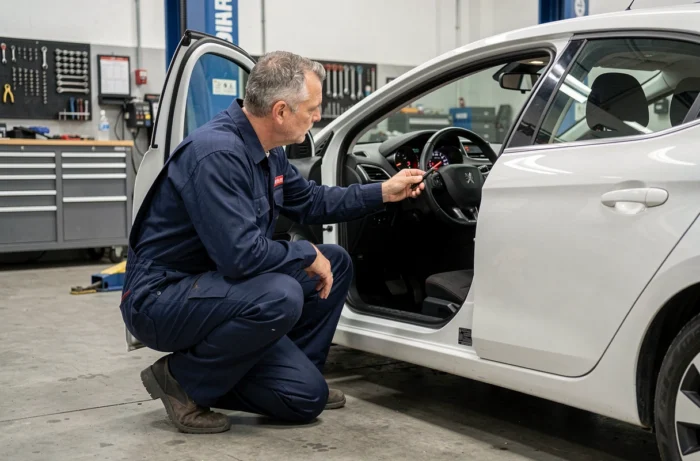
Identifying the color and symbol of a warning light gives a first indication, but only reading the fault codes via an OBD tool allows for a reliable diagnosis. The same orange engine light can correspond to dozens of different codes, from a simple oxygen sensor to a turbo issue.
On the 208 II, the central screen sometimes displays a supplementary message (“Engine fault, please repair the vehicle”, “Pollution risk”) that specifies the alert. These text messages, absent on the first generation, reduce ambiguity but do not replace a visit to the workshop.
The manufacturer’s manual, accessible via the Scan MyPeugeot app or the Service Box portal, remains the reference document for each warning/message combination. A manufacturer recall may concern a specific warning light without the owner being informed if their contact details are not up to date with the network. Regularly checking the recall status of the vehicle by its VIN helps avoid missing out on a free correction.